Navigating the world of gambling and sports betting can feel overwhelming at first. Between shifting lines, varied numerical formats, and specialized jargon, interpreting a betting board often resembles reading a foreign language. However, beneath the surface clutter, gambling odds rely on straightforward mathematical principles.
Understanding how odds work is the single most critical skill for anyone looking to evaluate wagers, assess risk, and manage a bankroll responsibly. Odds perform two essential functions: they express the mathematical probability of a specific outcome occurring, and they dictate exactly how much money you win if your wager succeeds. This comprehensive guide breaks down the primary odds formats, explains the underlying probability calculations, and illuminates how bookmakers structure lines to manage their own risk.
The Dual Purpose of Gambling Odds
Before examining specific formats, it is helpful to clarify what odds represent. At its core, any set of gambling odds serves two distinct purposes:
-
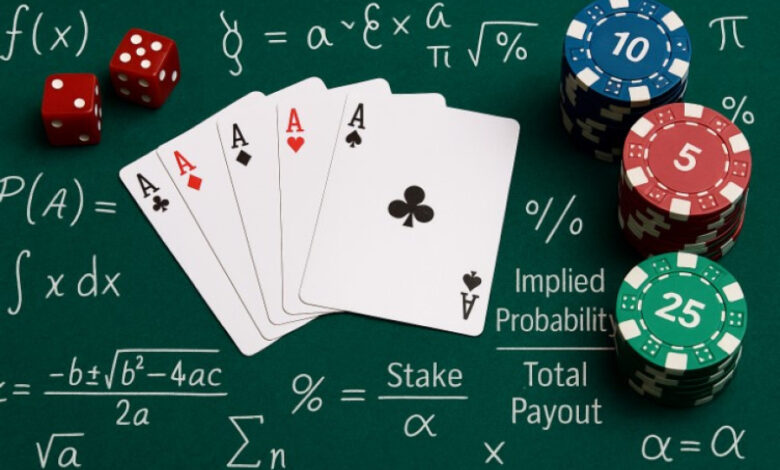
Implied Probability: Odds reflect the estimated likelihood of a particular event happening, expressed as a percentage. Lower odds indicate a higher probability of occurrence, while higher odds signal an unlikely event.
-
Payout Calculation: Odds dictate the financial ratio between your stake—the amount of money you wager—and your potential profit.
Recognizing that odds reflect both probability and potential financial return allows bettors to identify value. Value exists when a bettor calculates that the actual probability of an outcome is higher than the implied probability reflected in the bookmaker’s odds.
The Three Primary Odds Formats
Depending on where you are in the world or which platform you use, odds are presented in three standard formats: American (Moneyline), Fractional, and Decimal. While they look completely different on screen, they all convey identical mathematical information.
American Odds (Moneyline)
Predominantly used in the United States, American odds rely on a baseline metric of one hundred dollars. Lines feature either a plus sign or a minus sign preceding the number.
-
Minus Sign (-): Represents the Favorite. The number following the minus sign indicates how much money you must wager to win exactly one hundred dollars in profit. For instance, odds of -150 mean you must bet $150 to make a $100 profit. A successful wager returns your original $150 stake plus $100 in winnings, totaling $250.
-
Plus Sign (+): Represents the Underdog. The number following the plus sign indicates how much profit you win on a successful one-hundred-dollar wager. For example, odds of +200 mean a $100 bet yields $200 in profit. A winning ticket returns your original $100 stake plus $200 in winnings, totaling $300.
Fractional Odds
Commonly used in the United Kingdom and across traditional horse racing venues, fractional odds appear as two numbers separated by a slash, such as 5/1 or 2/5.
-
Understanding the Ratio: The first number (the numerator) represents the potential profit, while the second number (the denominator) represents the amount you must wager.
-
High-Yield Example (5/1): Staking $10 at 5/1 odds yields $50 in profit (5 times your $10 stake), returning $60 in total payout.
-
Favorite Example (2/5): Staking $50 at 2/5 odds yields $20 in profit (2/5 of your $50 stake), returning $70 in total payout.
To quickly calculate fractional payouts, multiply your stake by the top number and divide the result by the bottom number.
Decimal Odds
Dominant across continental Europe, Canada, Australia, and online betting platforms worldwide, decimal odds represent the simplest format for calculating total payouts.
-
Total Return Multiplier: Unlike American and fractional formats—which express net profit—decimal numbers represent the total payout (stake plus profit) returned for every single dollar wagered.
-
Calculating Payouts: To find your total payout, simply multiply your stake by the decimal number. For example, a $20 wager at decimal odds of 2.50 yields a total return of $50 ($20 x 2.50 = $50), which equals $30 in net profit and your $20 original stake.
Odds equal to 2.00 represent an even-money proposition (equivalent to +100 in American odds or 1/1 in fractional odds), where winning doubles your money.
Converting Odds to Implied Probability
To evaluate whether a wager is worth taking, you must convert odds into implied probability percentages. Comparing this mathematical probability against your own personal analysis helps you make informed choices.
Mathematical Formulas for Conversion
Converting odds to percentages requires simple math depending on the format you are viewing:
-
From Decimal Odds: Implied Probability = (1 / Decimal Odds) x 100. For odds of 2.50: (1 / 2.50) x 100 = 40 percent.
-
From Fractional Odds: Implied Probability = [Denominator / (Numerator + Denominator)] x 100. For odds of 3/1: [1 / (3 + 1)] x 100 = 25 percent.
-
From American Negative Odds: Implied Probability = [Negative Odds / (Negative Odds + 100)] x 100. For odds of -150: [150 / (150 + 100)] x 100 = 60 percent.
-
From American Positive Odds: Implied Probability = [100 / (Positive Odds + 100)] x 100. For odds of +200: [100 / (200 + 100)] x 100 = 33.3 percent.
The House Edge: Understanding the Vig or Juice
If you sum the implied probabilities of all possible outcomes in a sports event, you will notice that the total exceeds 100 percent. This extra percentage represents the bookmaker’s built-in fee, known as the overround, vigorish, or juice.
Bookmakers do not operate as charitable institutions; they earn profits by charging a small commission on transactions. By building a margin into the odds, the house ensures a long-term profit margin regardless of which side wins, provided wagers are evenly distributed across both sides.
Example of the Vigorish in Action
Consider a balanced coin toss event where two outcomes have a true 50 percent chance of happening. In a perfectly fair market, both sides would feature decimal odds of 2.00 (+100 American).
However, a bookmaker typically offers odds of 1.91 (-110 American) on both sides.
-
Implied probability of Side A (-110) = 52.38 percent
-
Implied probability of Side B (-110) = 52.38 percent
-
Total market probability = 104.76 percent
The extra 4.76 percent represents the bookmaker’s built-in profit margin. Understanding the vig helps bettors recognize why consistently beating sportsbooks requires maintaining a win rate higher than simple 50-50 odds suggest.
Key Considerations for Smarter Decision-Making
Mastering odds mechanics provides the analytical foundation needed to approach wagering methodically.
-
Shop for the Best Odds: Different sportsbooks frequently post slightly different odds for the exact same event. Finding decimal odds of 2.10 instead of 2.00 on a team increases your profit margin over time without adding extra risk.
-
Avoid Emotion-Driven Betting: Betting on your favorite sports team often creates a psychological bias where you overrate their actual chance of winning. Base choices on statistical probability rather than loyalty.
-
Manage Bankroll Disciplinedly: Never size your wagers based on emotional impulses or a desire to chase recent losses. Use a standardized unit system, betting a small, fixed percentage (such as one to two percent) of your total bankroll on any single event.
Frequently Asked Questions
What does EV mean in gambling and odds analysis?
EV stands for Expected Value. It is a calculation that determines the theoretical average profit or loss per bet over the long run. A positive EV (+EV) wager means the bet carries a mathematical advantage over the bookmaker’s line, while a negative EV (-EV) wager means the bet loses money over time.
Why do sports odds change prior to the start of a match?
Bookmakers adjust odds dynamically based on incoming betting volume, injury reports, weather conditions, and sharp market activity. If a massive amount of money is placed on one team, the bookmaker shortens their odds and lengthens the opponent’s odds to balance their financial liability.
What is the difference between betting the Moneyline and Point Spread?
A Moneyline wager is a straightforward bet on which team will win the event outright, with odds adjusted to reflect favoritism. A Point Spread bet introduces a handicap (such as -6.5 points for the favorite) to balance the contest, requiring the favorite to win by more than the specified margin for the wager to pay out.
What does PK or PICK mean on a sports betting board?
PK stands for Pick or Pick ‘Em. It occurs when two competing teams are considered completely evenly matched by the bookmaker. In a Pick ‘Em event, there is no point spread handicap, and the bettor simply selects which team will win the game outright.
Are higher odds always better for a bettor?
Not necessarily. Higher odds deliver a larger financial payout if you win, but they also reflect a significantly lower mathematical probability of occurring. Selecting successful wagers requires balancing payout potential against realistic likelihood.
How do parlay or accumulator odds work?
A parlay combines multiple individual bets into a single wager. The odds of each individual selection are multiplied together to generate a significantly higher total payout. However, every single selection must win for the parlay ticket to pay out; a single loss renders the entire ticket void.
What does even money mean in betting?
Even money refers to a wager where the potential profit equals the exact amount staked. In decimal format, even money is expressed as 2.00; in American odds, it is +100; and in fractional odds, it is written as 1/1. Winning an even-money bet doubles your total money returned.